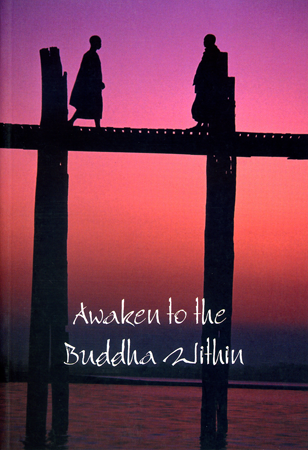
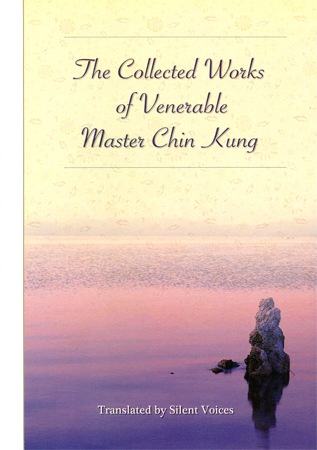
Beginning with his life, Awaken to the Buddha Within explores what the Buddha experienced from impermanence and causality to compassion and altruism. Understanding his teachings of morality, concentration, and wisdom will help us to find within ourselves the answers we are seeking today.
Chin Kung 淨空 Born 1927 Lujiang County, Anhui Province, China Senior posting Title Venerable Religious career Teacher Lee Ping-nan Chin Kung, AM (淨空; pinyin: Jìngkōng) (b. 1927) is a Buddhist monk from the Mahayana tradition. He is the founder of the Corporate Body of the Buddha Educational Foundation, an organization based on the teachings of Pure Land Buddhism. He was born in Lujiang County, Anhui Province, China under the birth name of Hsu Yeh-hong (Xú Yèhóng 徐業鴻). He spent thirteen years studying Buddhism and Philosophy under the guidance of Professor Fang Tung-mei (方東美), Changkya Khutukhtu (章嘉呼圖克圖 a master in Mongolian Buddhist tradition), and lay teacher Lee Ping-nan (李炳南). He entered the monastic life in 1959, where he was ordained at Lintzi Temple at Yuanshan in Taipei, Taiwan. It was then that he received the name of Chin Kung, meaning "pure emptiness". Master Chin Kung is well known for using modern technology to spread the Buddha's teachings. His lectures are recorded on audio, video tapes and CDs for wide distribution in many temples, including many Buddhist temples and centers where people can pick up books to distribute to other places. He has sponsored the printing and the distribution of Buddhist texts worldwide, as well as portraits and pictures of various buddhas and bodhisattvas. All these items have been distributed free of charge. In recent years, Chin Kung has emphasized the Infinite Life Sutra and the Pure Land cultivation method of Buddha recitation which is concerned mainly with the recitation of Amitābha Buddha's name.
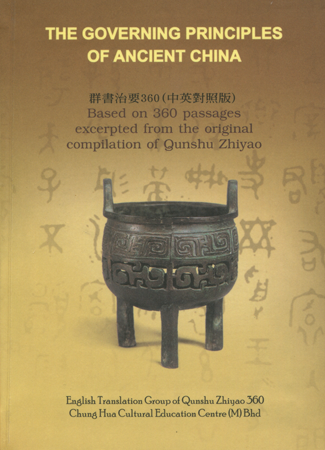
THE GOVERNING PRINCIPLES OF ANCIENT CHINA 群書治要360 (中英文對照)
編號
HZ35-11-01
規格
特32開 圓背軟精裝(11*17公分)
庫存量
36
簡介
At the beginning of the Zhenguan Era, Emperor Taizong (599-649) of the Tang dynasty decreed that Qunshu Zhiyao (The Compilation of Books and Writings on the Important Governing Principles) be compiled. At the tender age of sixteen, Taizong enlisted himself in the army, and joined his father’s forces to try to stop the turmoil that was going on in the society. For more than ten years, he dwelt himself in military matters. After he ascended to the throne at the age of twenty-seven, he laid down his armor and began to promote culture and education, paying particular attention to the principles of governing, and bringing peace to the country. He sought to rejuvenate the nation from the aftermath of civil strife by restoring order to life, lessening the burdens of ordinary people, and increasing prosperity.
Although Taizong was an intelligent, brave, and eloquent man, he regretted that his earlier military expeditions had prevented him from obtaining much formal education. He also learned from the mistakes made by the fallen Sui dynasty and realized that to start a new dynasty was no easy task, and to sustain it would be even harder. Hence during his reign, he encouraged his ministers to point out his mistakes and to candidly criticize his imperial policies. To make up for lost time, Taizong ordered two advisors, the honorable Wei Zheng and Yu Shinan, to comb through all the historical records on imperial governing principles from the Six Classics, the Four Collections of History and the Hundreds of Schools , and to extract the most important lessons related to the cultivation of oneself, management of family, good government, and ways to bring about peace in the world. The result was a collection, titled Qunshu Zhiyao, carefully excerptedfrom 14,000 books and 89,000 scrolls of ancient writings—500,000 words in all, and covering sixty-five book categories—dating from the era of the Five Legendary Emperors to the Jin dynasty.